Ekofuturium
Competition for the development of a conceptual design for the construction of the EKOFUTURIUM Centre for Sustainable Development in Koszalin
- location: Koszalin, Poland
- architects: Przemo Łukasik, Łukasz Zagała, Frédéric Chartier, Pascale Dalix, Mickaël Hassani,
- associate architects: Patrick Bourgeois, Dorota Pala, Izabela Moskal, Mateusz Robak, Maciej Urban, Greta Milstein, Sandra Przepiórkowska, Mateusz Grela,
- landscape design: Kevin Michels
- visualisations: Walter Stefani, Claudio Canesso, Alessandro Bellini, Arnaud Maley
- plot area: 23 003 sqm
- construction area: 3 510 sqm
- total area: 6 600 sqm
- biologically active area: 15 900 sqm
- design: 2025
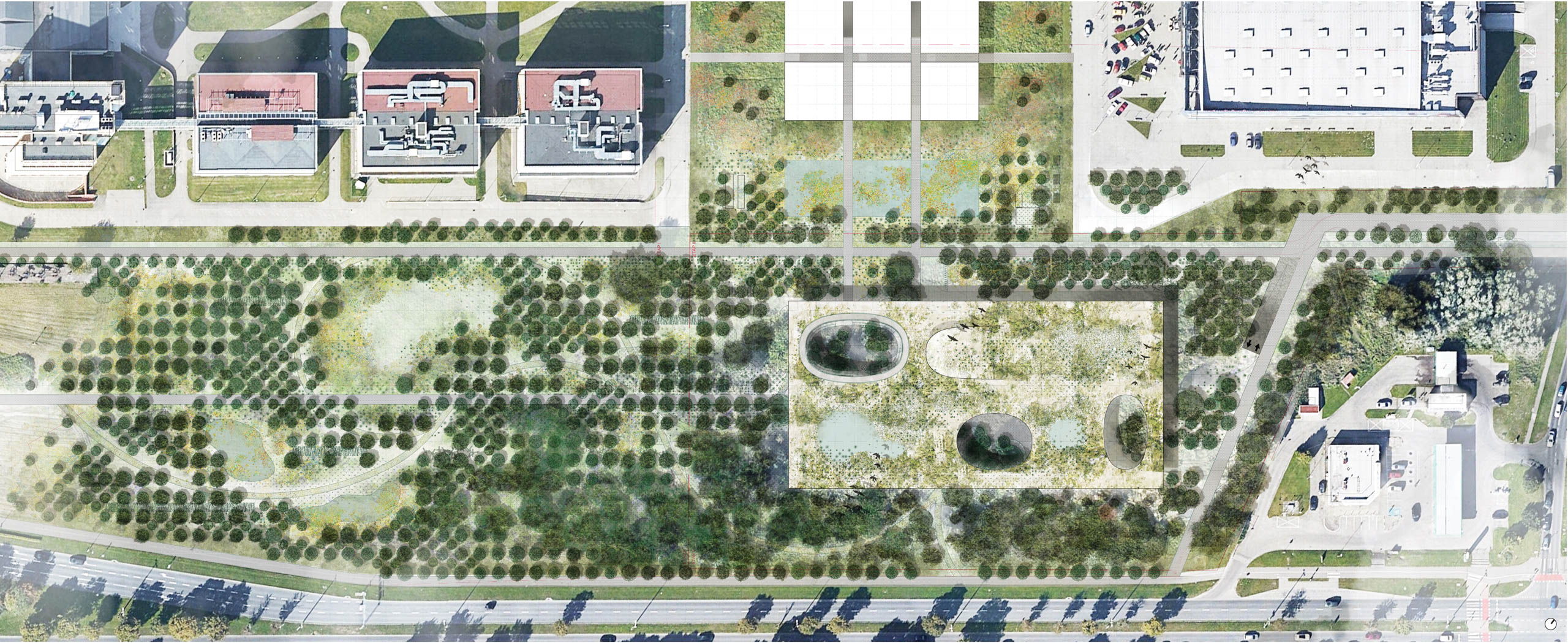
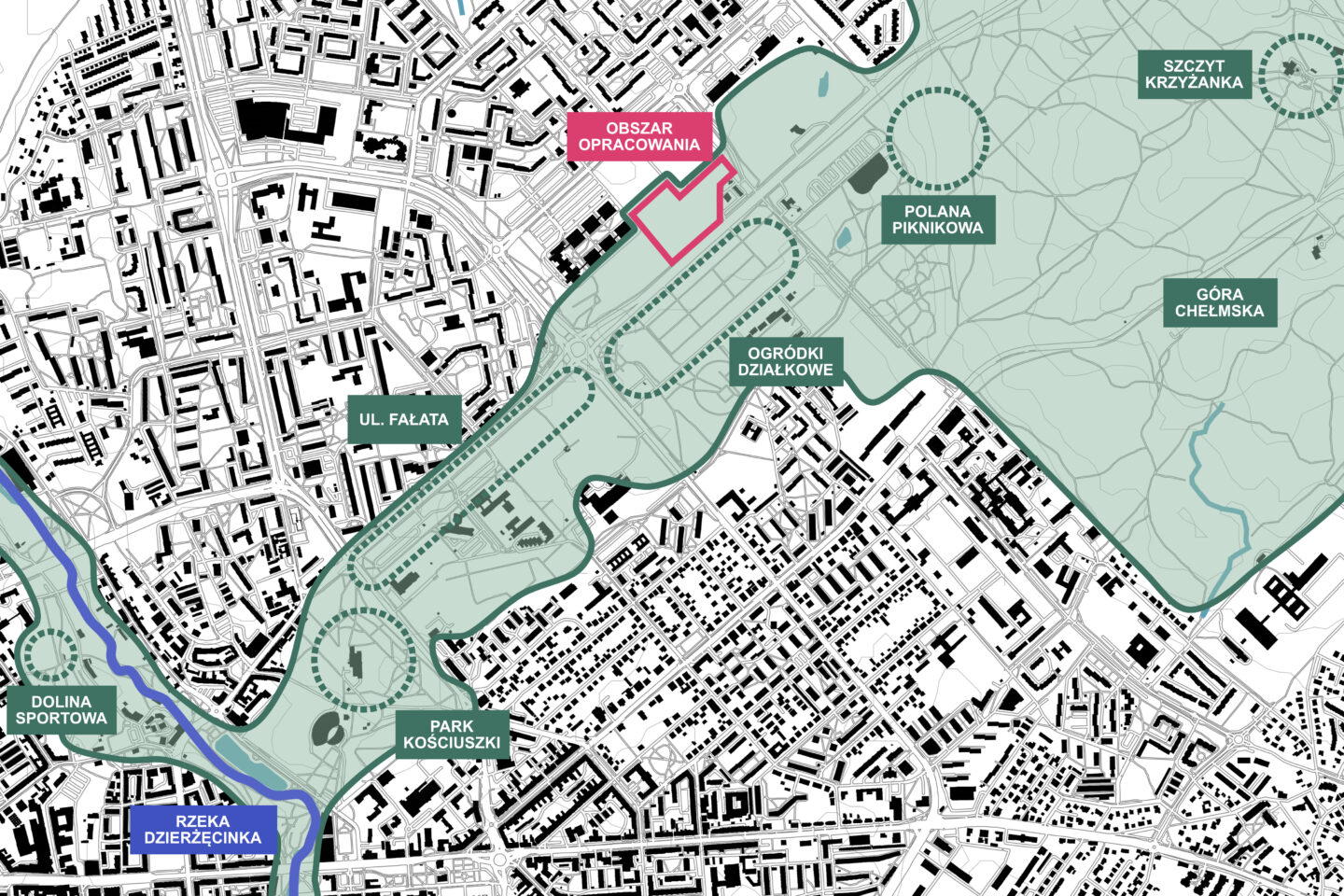
The area covered by the competition is a highly exposed area visible from many perspectives. For many years it has been awaiting a proper architectural intervention, due to its location at the entrance to the city and in the vicinity of visitor-generating facilities such as the Koszalin University of Technology (with the Cognitarium building currently under construction), the Sports and Entertainment Hall or the Water Park, as well as being the foreground for the artistic showpiece of the city – the installation ‘Flaming Birds’ by Władysław Hasior. The plot is overgrown with untidy greenery, with a lot of self-sown trees, among which large trees also grow.
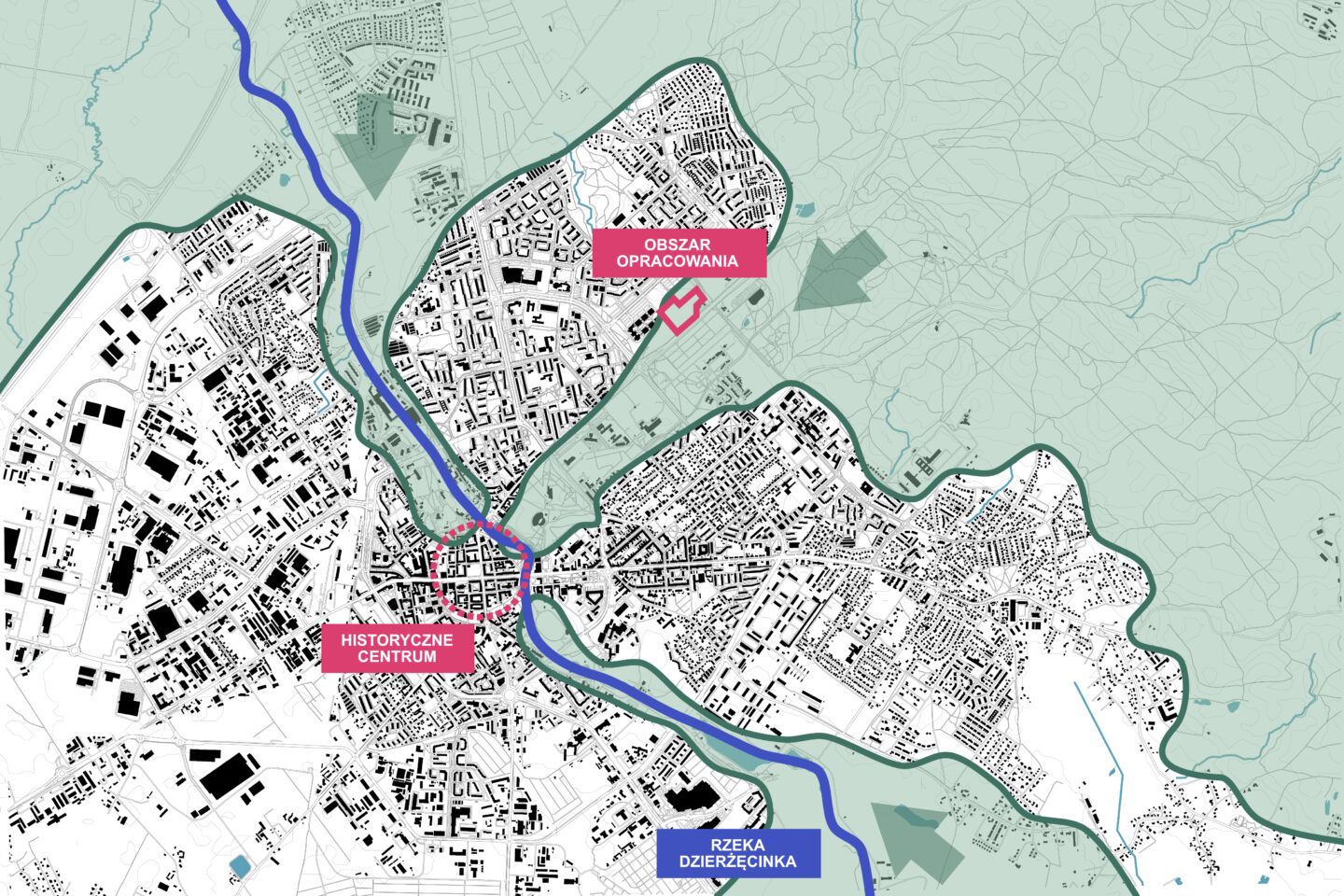
Analysing a map of Koszalin and the surrounding area, it can be seen that as much as 40% of the city area is covered by greenery, most of which consists of woodland. However, two ecological corridors clearly run through the city centre. The first one is situated in a north-south direction along the Dzierżęcinka River and the second one in an east-west direction from the city centre towards the forested areas in the eastern part of the city – as far as the village of Sianowo.
Today’s urban nature systems strive to connect areas that form urban greenery, both those long-established in the structure of the city, such as parks or gardens, and those created relatively recently.
This assumption allowed us to think that the incorporation of the planned EcoFuturium facility into the green infrastructure, which is being supplemented with new resources, will not only be of value to the surrounding areas, but will also have an impact on the entire city and region.
IDEA
The main idea of the project is to strengthen the blue-green infrastructure of Koszalin by extending the connections between the forest areas and the historic city centre.
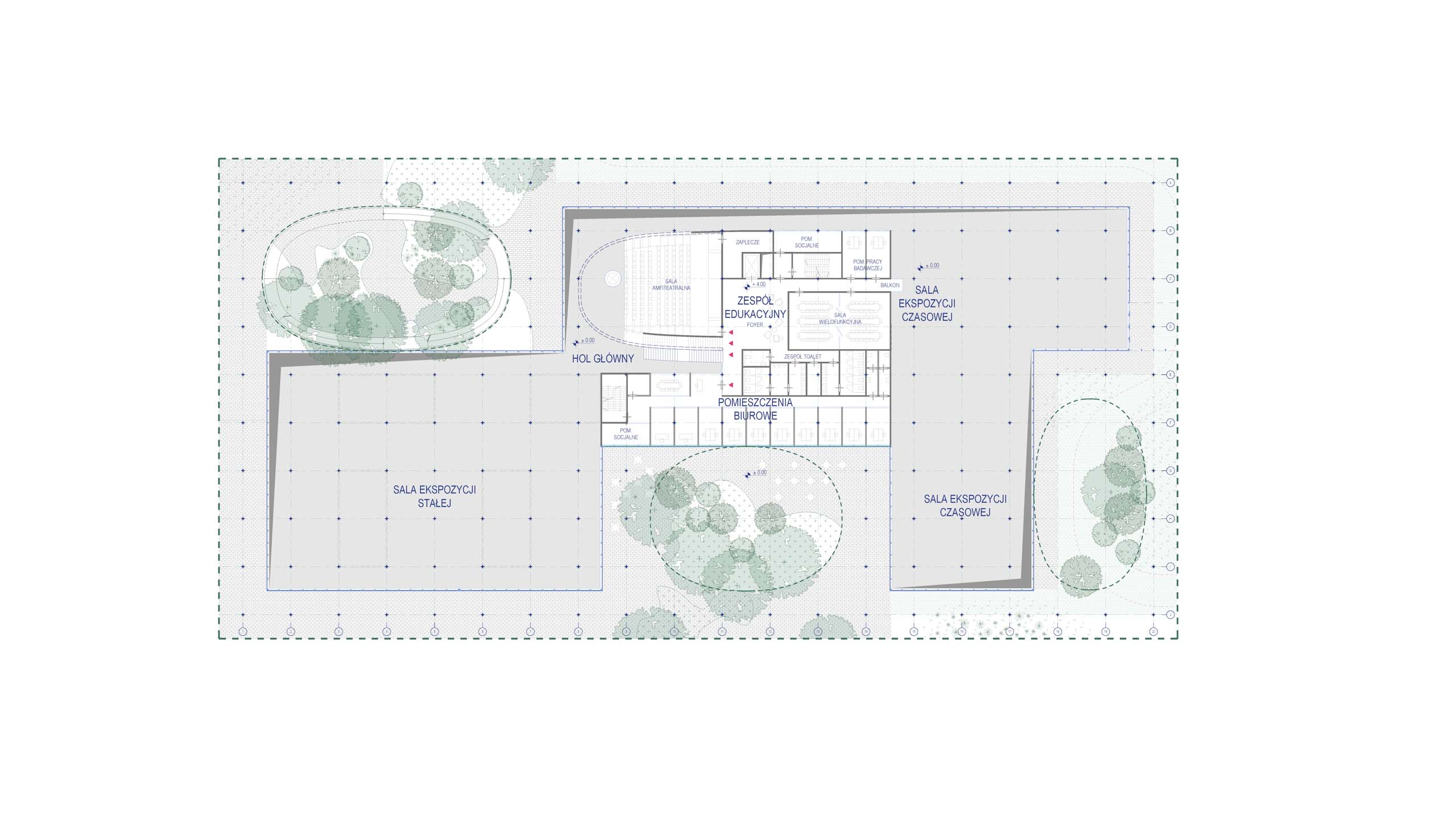
The location of the designed Ekofuturium building has been determined on the basis of a dendrological analysis – at the site of an unwooded area, preserving the existing trees as much as possible. Organising the main functions of the building around courtyards allows direct contact with nature in all exhibition spaces. The new architecture is intended to blend in with the surrounding greenery and should close the view and communication axis with the neighbouring Cognitarium building.
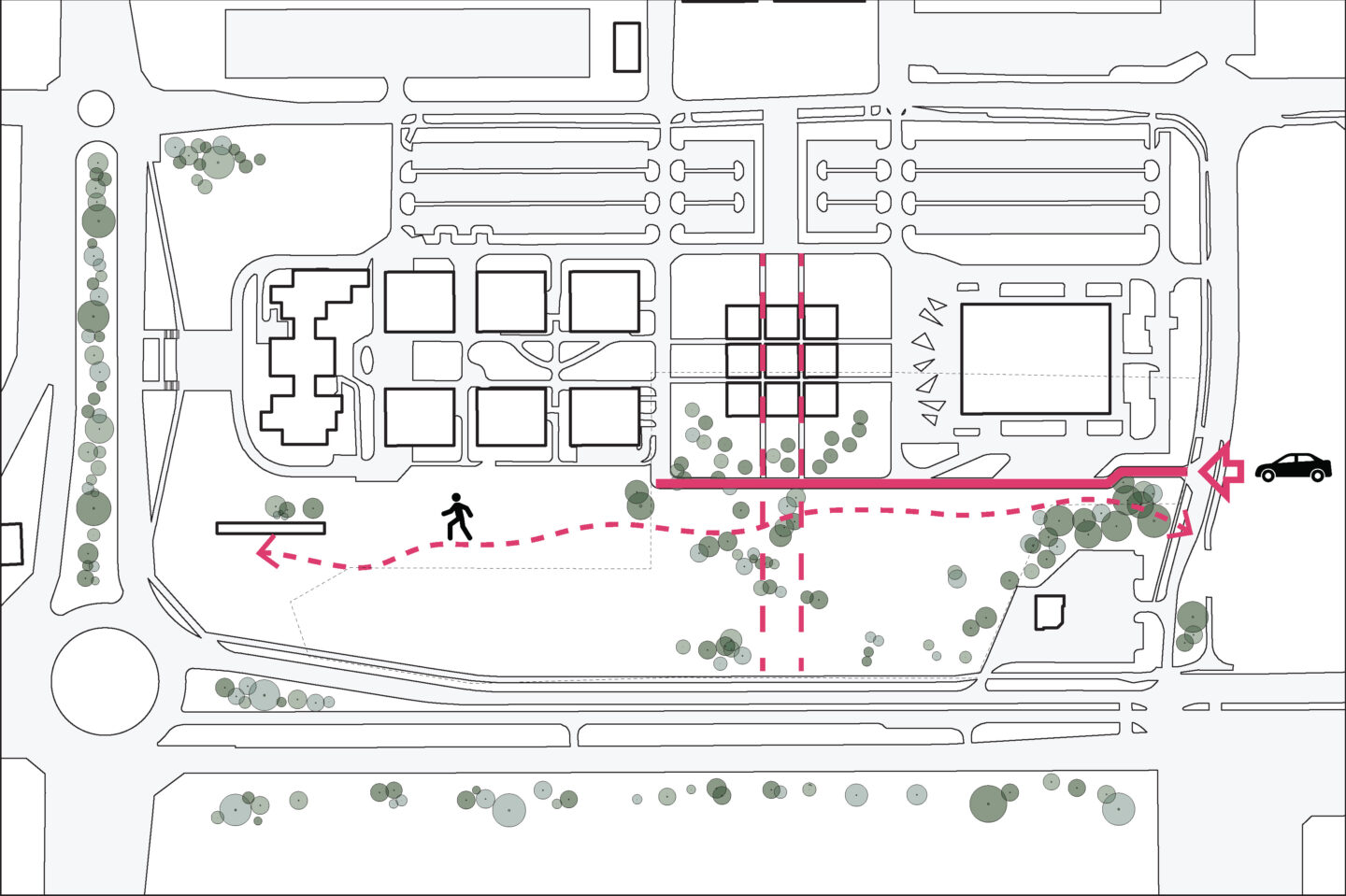
The development of the area around the Ecofuturium will be a public, open space that consistently follows the east-west pedestrian traffic axis from the city centre towards the woodland in the eastern part of the city.
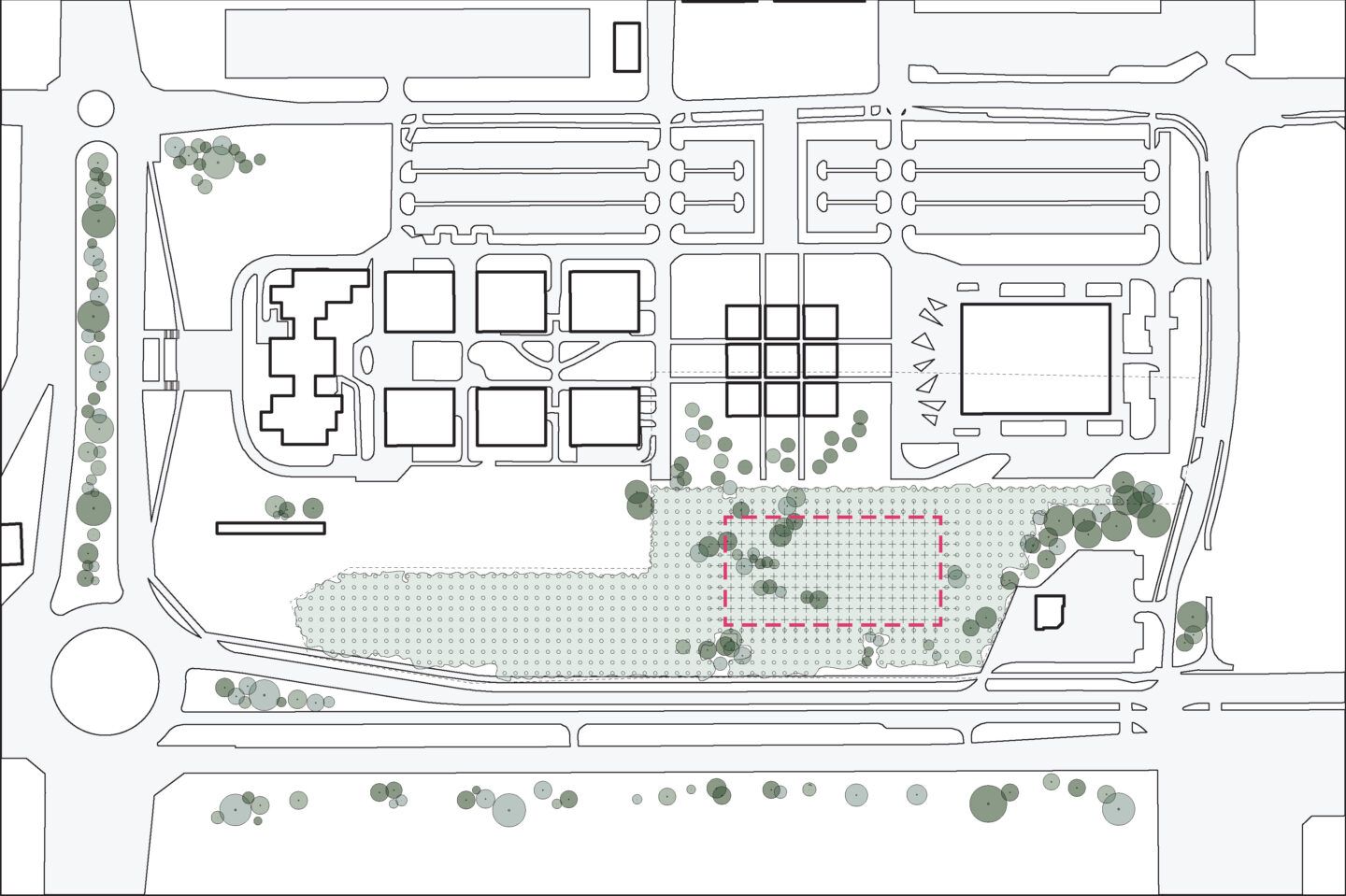
The forest and the use of a rectangular grid to plan plantings or assumptions such as the allotment gardens found in the urban area served as inspiration for the design. Both the regeneration process of the forest and the structure of the gardens are delineated on an orthogonal grid. The grid delineated for the new plantings, continues on the site of the planned development – it passes into the structural grid of the proposed building. The way in which the building has been integrated into the landscape means that the existing vegetation can be retained as much as possible.
The area of land occupied by the building will be returned to the environment in the form of a green roof area, where it is planned to create a bird sanctuary. The large wetland area, a moving landscape that changes with rainfall, will provide an ecological stop-off point in the network of natural areas and reserves around Koszalin, and the vantage point and observation post from the building will be an additional attraction for visitors to the EcoFuturium.
The designed forest park will have an educational (Experimental Garden) and recreational function, in the immediate vicinity of the buildings of the Technical University, the Cognitarium and the Sports and Entertainment Hall. The establishment of the park is an opportunity to carry out a renaturalisation process and invite the citizens of Koszalin to a joint initiative – planting an urban forest. Each tree planted can be labelled and refer to the people who planted them as social symbols. Along the walking paths, several thematic clearings will be landscaped to promote biodiversity and nature education and the assumptions of the Experimental Garden planned for the Ecofuturium.
The unambiguous visual connection between the forest park and the building offers potential of supra-regional significance. The striking form, but very economical massing, combined with high-quality materials, enriches and complements the vision of Koszalin as a city of innovation. The building can therefore aspire to become a new icon of Koszalin.
The design intention is not to compete with the Cognitarium, which is already under construction, but on the contrary: the Cognitarium, with its more internal, closed concept, works well with the idea of opening up the building to the outside. The designed building, set in the heart of the forest, with a clearly horizontal layout, does not dominate the surroundings, but becomes part of them. The building is designed to respect nature and blend in with its natural rhythm. In turn, the proximity to the urban infrastructure allows us to think that the project is not only functional, but also in line with the needs of a rapidly developing academic environment.
FUNCTIONAL AND UTILITY SOLUTIONS
With a clear horizontal layout, the building organises internal functions around courtyards that allow direct contact with nature in all exhibition spaces. The facades of the building are designed as curtain walls, allowing a continuous correspondence between the interior and the surroundings. As one moves up to the next storey of the building, further parts of the surrounding forest are visible.
The functional elements of the building are centralised and as compact as possible for the intended functional programme. The exhibition halls and rooms of the research section are located on the ground floor. They are accessible directly from the entrance area, where a cafeteria is also planned. The exhibition halls have been designed as large, rectilinear open spaces, on an orthogonal grid, so that they can be easily converted for other purposes in the future.
On the first floor, the training and conference area and a set of offices are located, while the top floor, above the green roof, is an auditorium with an observation terrace that offers views of the treetops and the green roof. The roof level can also be reached directly from the entrance patio, via a monumental viewing gallery accessible to the public. The glazed façade of the winter observation terrace will be screen-printed to ensure the safety of passing birds.
The green roof area, which is intended as a refuge for birds and insects, will be landscaped with respect for biodiversity. Access to the green area is reserved for the animals and the role of the visitor is limited to that of an observer only.
Due to the purpose of the roof, all technical equipment will be located on the underground floor. A car park, storage and workshop rooms for the preparation of the exhibition, and technical rooms necessary for the building infrastructure are also programmed in the basement.
Access to the building is designed from Chrząszczyńskiego Street. The communication system is organised from the north (fire road) and east (access to the car park and technical zone located in the underground). The designed communication system, in accordance with the Organiser’s expectations, assumes a connection with the existing communication system of the facilities of the University of Technology, as well as preserving the pedestrian paths from the Cognitarium building. However, we did not consider it reasonable to connect the Ecofuturium and Cognitarium buildings at the underground floor level.
MATERIAL, TECHNICAL AND TECHNOLOGICAL SOLUTIONS
The building envisages the use of technologies and system solutions that are highly efficient, ahead of current standards and create a user-friendly environment. The aim is to provide the highest indoor comfort for users, to make efficient use of low-carbon and renewable energy sources, to reduce the building’s operating costs, to reduce the negative impact on the environment and to achieve a low-energy building lifecycle. It is assumed that the building will be adapted to the requirements of blue-green infrastructure (e.g. retention, installation of ‘grey water’) and the use of primary heat sources: earth/water, also waste water/air. Waste heat recovery from the ventilation and waste water system (waste-water heat pump) is envisaged.
The choice of materials during the design and construction of the project will be dictated by measures to reduce the carbon footprint, also by using local materials to reduce their transport.
The roofs of the facility are ‘green roofs’ (intensive and extensive), planted with biodiversity, which will significantly increase the retention of rainwater, which is planned to be collected in roof cavities (for use by resident and visiting animals) and in retention tanks, for irrigation of the green areas around the building and use for flushing in the toilets in the grey water system. The air handling units are expected to use sorption heat and moisture recovery exchangers and an integrated heat pump operating at variable capacity depending on the CO2 concentration in the rooms. The facility will be equipped with modern, energy-efficient LED lighting with a colour temperature close to natural light. An energy-efficient natural and artificial lighting control system, including a daylight control system that adjusts the intensity of lighting in the building to the intensity of natural light, will allow the creation of lighting conditions close to those naturally occurring in the environment. Lighting and presence sensors are planned to be installed in the rooms.
ECOLOGICAL SOLUTIONS
The planned Ekofuturium building offers not only an enrichment of Koszalin’s educational or recreational offer, but also an improvement in the quality of the city’s green spaces. An additional advantage is the planning of an area of the building dedicated solely to animals – in particular birds and insects.
The concept assumes the preservation of some of the existing trees as well as numerous new plantings, preserving the biodiversity of the species. The project assumes the preservation of the maximum number of existing trees. It is estimated that it will be possible to preserve around 80% of the number of trees with a trunk diameter of more than 50cm. New plantings have been designed over the entire area of the development site, which will provide a robust green resource to filter suspended dust in the urban area.
The green roof, which is a surface designed for birds and insects, combines a number of functions to reinforce the building’s eco-friendly character. The roof provides excellent insulation for the building – preventing cooling in winter and overheating in summer. The designed eaves protect the rooms in the research and office area from excessive heat gain. In addition, the slope of the roof surface helps to collect rainwater more efficiently for re-use.
The grey water and rainwater management system for the planned building and the Experimental Garden will work in an integrated way to make the best use of a valuable resource such as water.
It is planned to use building materials with a low carbon footprint, such as low-emission timber or CLT timber. The use of wood also allows for a harmonious transition between indoor and outdoor spaces. The effect will be enhanced by using a corresponding structural grid and a grid of new planting.
A map of Koszalin’s resources should also be created at the stage of project documentation in order to make it possible to reuse investment material on a city-wide scale. Tenders and competitions should be analysed to identify investments that enable synergies in terms of public investment in Koszalin. In order to make full use of city resources, infrastructure and buildings (e.g. vacant buildings not suitable for adaptation) that can serve as material banks should be identified. Building materials that can be reused include concrete and reinforced concrete rubble (as fill material, backfill, sub-layers for road construction or for drainage layers), asphalt and asphalt aggregate, excavation soil for reclamation. Potential can also be found in large-scale structural elements (e.g. prefabricated elements) or steel construction elements, which can easily be used, e.g. as small architecture, in the landscaping of the area adjacent to the EcoFuturium building.
In order to make the conditions inside the building as similar as possible to those outside, the display is illuminated with natural light during the day and with energy-efficient luminaires with a light colour close to natural light in the evening.
New technologies are planned for the building, e.g. heat pumps, heat recovery exchangers and a biosolar roof.
SITE BALANCE FOR THE PLOT 19/17
| Plot area: | 23 003 sqm | |
| Construction area: | 3510 sqm | |
| Total area: | 6600 sqm | |
| Biologically active area: | 15 900 sqm | |
| Building intensity index: | 0,29 | maks: 1,2 |
| Build-up area ratio in relation to plot area: | 0,15 | min: 0,4 |
| Index of biologically active area: | 0,69 | min 25% |
| Building height: | 13,7 m | min 12m, max 24m |
| Number of storeys above ground: | 3 | min 3 max 7 |
| Number of underground storeys: | 1 | |
| Number of parking spaces for the building: Number of parking spaces per plot 19/17: | 128 43 | permitted balancing of 85 mp at the car park in Śniadeckich Street |
ESTIMATED BUILDING AREA BALANCE
| Useable area of the building | 5280 sqm |
| including: | |
| Floor -1 | 1840 sqm |
| Parking | 740 sqm |
| Technical rooms | 320 sqm |
| Social rooms | 100 sqm |
| Main warehouses and workshop | 680 sqm |
| Flor 0 | 2720 sqm |
| Main entrance complex: | 500 sqm |
| Cafe: | 80 sqm |
| Toilet complex: | 80 sqm |
| Research area: | 250 sqm |
| Exhibition area: | 1810 sqm |
| Floor 1 | 670 sqm |
| Training and conference area | 400 sqm |
| Toilet complex | 80 sqm |
| Office rooms | 200 sqm |
| Floor +2 | 65 sqm |